


1. General Introduction / Course Learning Outcomes
General introduction:
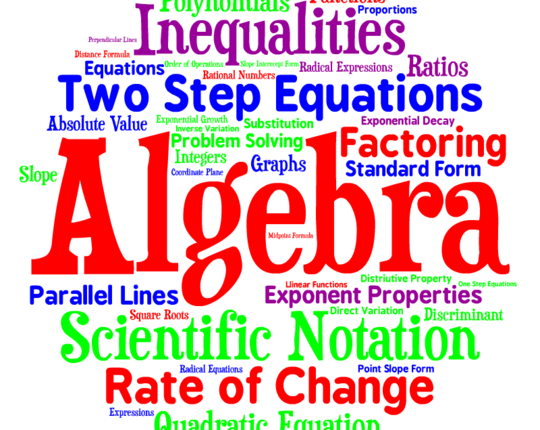
Algebra II is a college-preparatory mathematics course that builds on Algebra I and Geometry by deepening students’ understanding of functions and how they model relationships. The course serves as a key bridge to advanced mathematics such as Pre-Calculus or AP Calculus, and passing this course is required for graduation. Students investigate multiple function families, analyze their graphs and properties, and apply them to solve increasingly complex equations and real-world problems.
Learning outcomes:
By the end of the course, students can:
-
Use logical thinking and problem-solving strategies to analyze and solve multi-step mathematical problems.
-
Understand the concept of a function and interpret how functions represent relationships between quantities.
-
Analyze and compare function graphs and key features (e.g., intercepts, rate of change, growth/decay behavior) to make predictions and justify conclusions.
-
Apply function knowledge to solve a variety of equations and inequalities in both mathematical and real-life contexts.
2. Content Overview
The Algebra II curriculum emphasizes functions and their applications:
-
Functions: definition and representation of functions; investigating different types, their graphs, and their properties.
-
Key function families: focused study of
-
Linear functions
-
Quadratic functions
-
Exponential functions
-
Logarithmic functions
-
-
Equations and inequalities (applications of functions): using function concepts to solve
-
Linear equations and inequalities
-
Systems of equations and inequalities
-
Radical equations and inequalities
-
3. Learning and Teaching Approach
Instruction follows scalable, standards-aligned models designed to ensure mastery:
-
Backwards design: lessons are planned from clear end goals—what students must know and be able to do—then aligned assessments and learning activities are built to match.
-
Blended learning: students access core content through teacher-created instructional videos, while interactive time focuses on guided practice, small-group support, and personalized coaching.
-
Inquiry-based learning: students explore patterns, test strategies, and develop reasoning rather than relying on rote memorization.
-
Personalized instruction: pacing and support are adapted through each student’s Personalized Learning Profile, ensuring students progress with strong understanding and targeted help where needed.
 Lessons: