


1. General Introduction / Course Learning Outcomes
General introduction:
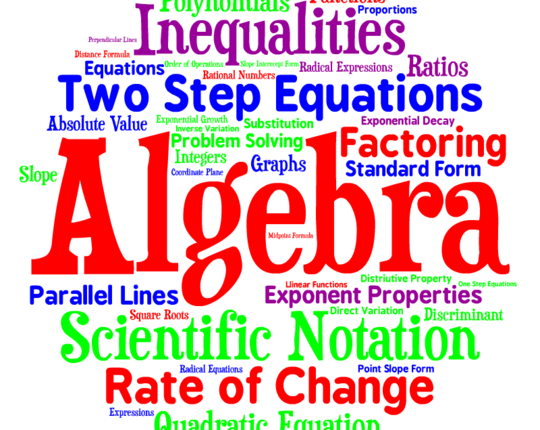
Algebra I is the first foundational course in the college-preparatory mathematics sequence. It is a one-year course that fulfills the Algebra I math sequence requirement and is required for graduation. The course helps students move from “following procedures” to “thinking with symbols”—using algebra to represent, analyze, and solve problems.
Learning outcomes:
By the end of the course, students can:
-
Build a strong algebraic foundation to prepare for higher-level courses such as Geometry, Algebra II, and advanced mathematics.
-
Develop logical reasoning, problem-solving skills, and connect mathematics to real-world applications.
-
Write and solve equations and inequalities (especially linear), and work flexibly with algebraic expressions.
-
Work confidently with key function families (linear, quadratic, exponential)—representing, analyzing, interpreting, and applying them in context.
2. Content Overview
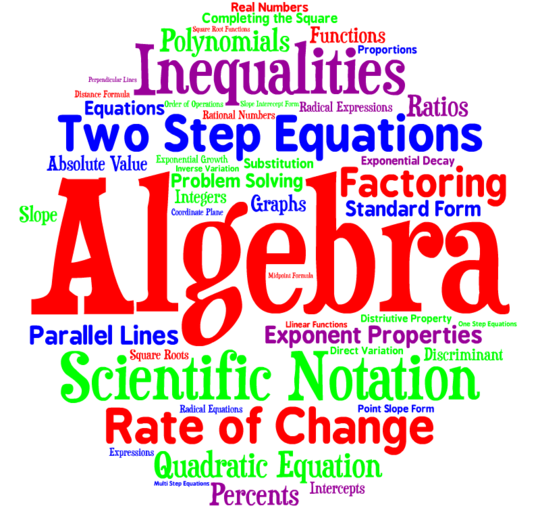
Algebra I focuses on the following core areas:
-
Real numbers and their properties: number systems, absolute value, and properties that support algebraic reasoning.
-
Equations and inequalities: writing and solving linear equations/inequalities and interpreting solutions in context.
-
Algebraic expressions and transformations: constructing, simplifying, rewriting equivalent forms, and evaluating expressions.
-
Polynomials and factoring: working with polynomials and applying factoring techniques.
-
Functions and modeling:
-
Linear functions
-
Quadratic functions
-
Exponential functions
-
-
Statistics and probability: foundational data analysis and probability concepts.
3. Learning and Teaching Approach
The online course is designed for “learning to do,” using modern instructional models:
-
Inquiry-based learning: students explore patterns, test strategies, and draw conclusions rather than memorizing formulas.
-
Blended learning: students learn through teacher-created video lessons; interactive work focuses on practice, error correction, and targeted support.
-
Backwards design: lessons are planned from intended outcomes to ensure activities and assessments align with academic standards.
-
Personalized instruction: learning is adjusted to students’ pace and ability using progress tracking and individualized pathways.
-
Project-based learning (PBL/STEAM): real-world tasks and cross-curricular projects help students apply algebra to meaningful problems.
 Lessons: